
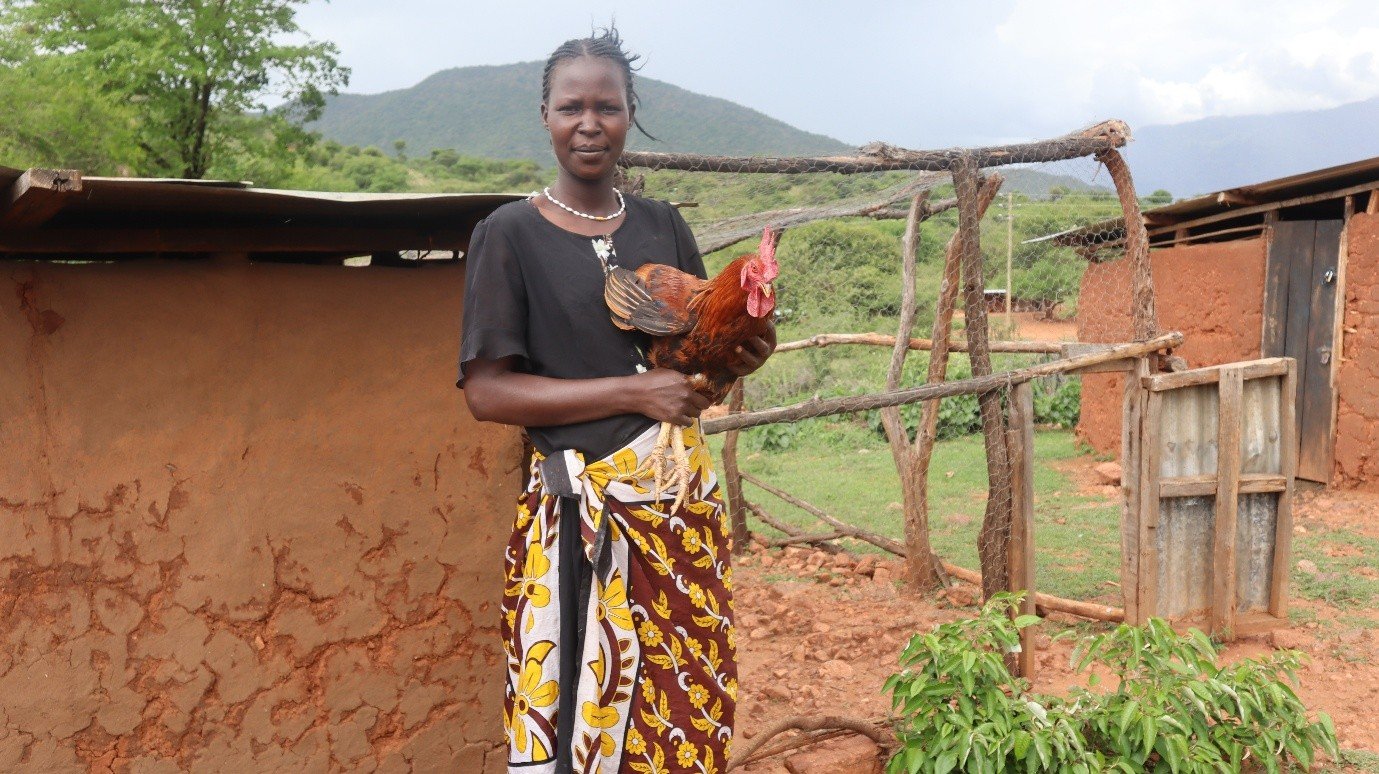
 Regina Chepkemei with a rooster from her poultry farm in West Pokot
The morning sun over Chelagatel village in West Pokot no longer finds Regina Chepkemei scanning the horizon for casual labor. Gone too are the days of chasing teaching positions at rural private schools where pay depended entirely on whether parents could settle their children’s fees, making the work feel more like voluntary service than a career.
Today, the 31-year-old mother of three begins the day in her happy place, her poultry pen. She moves through the birds with quiet confidence, greeting them, checking their health, and applying the livestock skills she developed through HER Lab. Her mornings are now defined by work she owns and income she can count on. “Before, I had to ask my husband for money for every small thing. Now I decide what my family eats, when they get new clothes, and how I will grow my business,” she says.
Although Regina earned a certificate in Early Childhood Development, teaching job opportunities never materialized. The few private schools in her rural area pay teachers only when parents settle school fees, and in communities marked by extreme poverty, fee arrears are common, making teaching positions closer to voluntary service than stable employment.
Faced with these realities, Regina took on casual labor when it was available. With three children and daily needs to meet, planning rarely extended beyond the week, and starting a business felt out of reach. She knew she needed both capital and practical training to make the leap.
Regina’s experience reflects the barriers common to rural women across Kenya. As a mother of three with an unemployed husband, she shouldered the full burden of childcare and household responsibilities while trying to earn an income. Limited access to capital and financial services prevented her from building economic security. According to the 2024 FinAccess Household Survey, rural women in Kenya face similar constraints, with digital literacy gaps and a lack of collateral, leaving many more exposed to financial shocks.
Through the HER Lab pilot program in partnership with Mastercard Foundation and implemented on ground by Perur Rays of Hope in West Pokot, Regina gained practical skills in entrepreneurship, agriculture, and financial management, alongside mentorship, personal development training, and reproductive health education. Designed as a 12-month workforce readiness and economic empowerment model, HER Lab equips young women with the skills, confidence, and real-world experience needed to transition into dignified and fulfilling work.
At the end of the program, Regina received a grant which she invested in launching and growing her poultry business. HER Lab is a Global Give Back Circle program with 13 years of track record, now being scaled through the Economic Empowerment 4 HER program in partnership with Mastercard Foundation, deepening economic empowerment and financial inclusion for young rural women in ASAL communities. Implementation through locally rooted partners, is central to the program’s transformational impact on the young women participants, their families and their wider communities.
Using her new skills, Regina began keeping records, tracking eggs collected and sold. Her income became more predictable as a result. She collects and sells eggs weekly, earning a modest but reliable income. When she lets the eggs hatch, the growing flock adds to her earning power, and every few weeks she sells mature chickens at KES 1,000 each, providing meaningful income boosts. This steady flow allows her to cover household expenses, reinvest in the business, and plan ahead. “I never thought I could make money every week. Now I can provide for my family without relying on others,” she says.
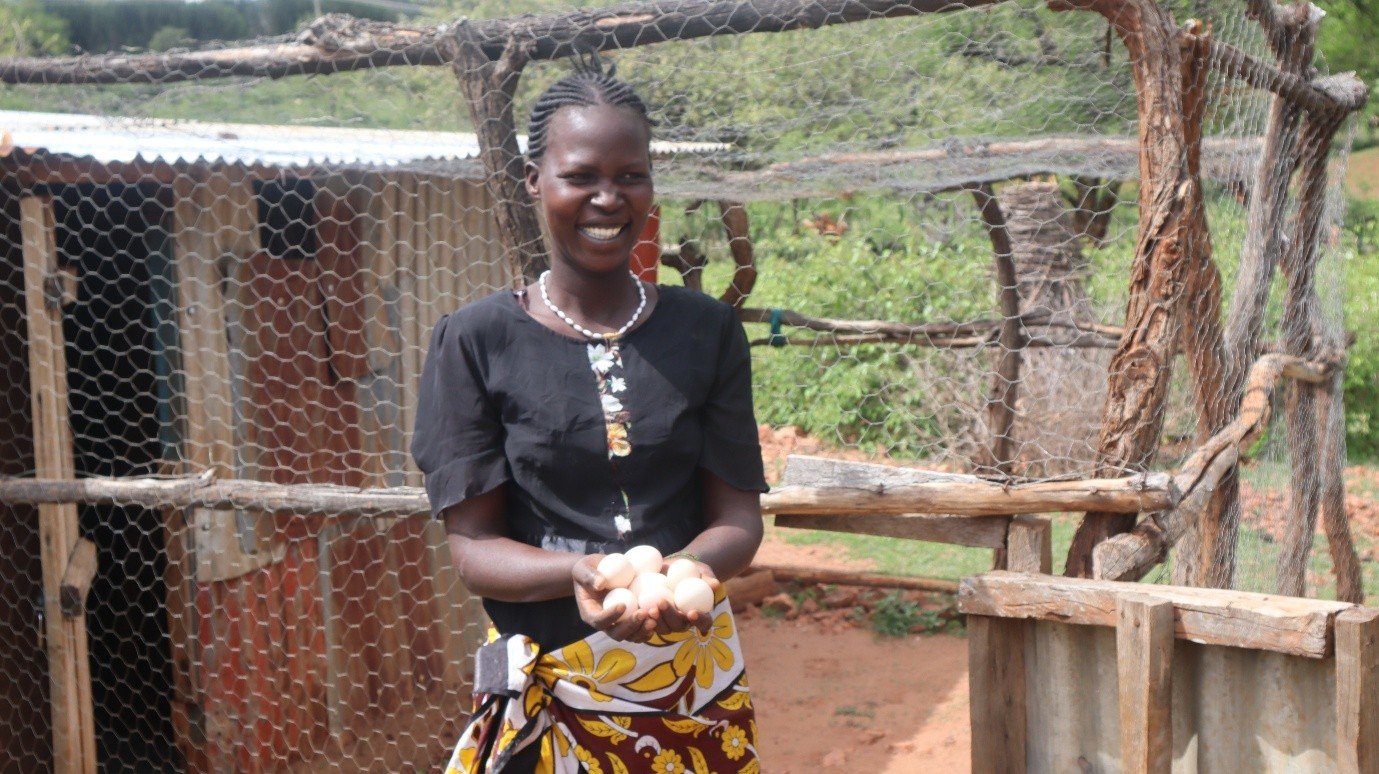 Regina showcasing yields from her poultry business
At any given time, Regina maintains a flock size of at least 40 chickens, more than double what she started with. This has increased both her sales and her ability to plan for the future. She sells primarily to neighbours and local market vendors, ensuring a consistent customer base.
The income now supports school fees, uniforms, food, and small household investments, including the rebuilding of her house. With a goal of diversifying her income and building on the entrepreneurship skills gained through HER Lab, Regina is now saving to launch a second business, a clothing boutique.
Through HER Lab, Regina gained far more than capital and skills training. She gained real agency, control over her income, her time, and her decisions. Today, her work is no longer defined by uncertainty. She earns, plans, and provides with confidence, building her future on her own terms in West Pokot, Kenya.