
Give to Gain
How a chance mentorship between two women became a lifelong exchange of opportunity, trust, and purpose
When I first walked into Hope Murera’s boardroom, the chemistry between the two women in front of me was unmistakable. They looked like old friends catching up; laughing easily, leaning into each other’s sentences, finishing each other’s thoughts. What struck me first, however, was something unexpected. They were dressed almost identically. Black and white.
Hope stood behind Mirriam’s chair in a striped jacket and a flowing white skirt dotted with black. Mirriam sat smiling beside her in a black dress trimmed with white. Neither had planned it. They only noticed once we pointed it out. They burst into laughter.
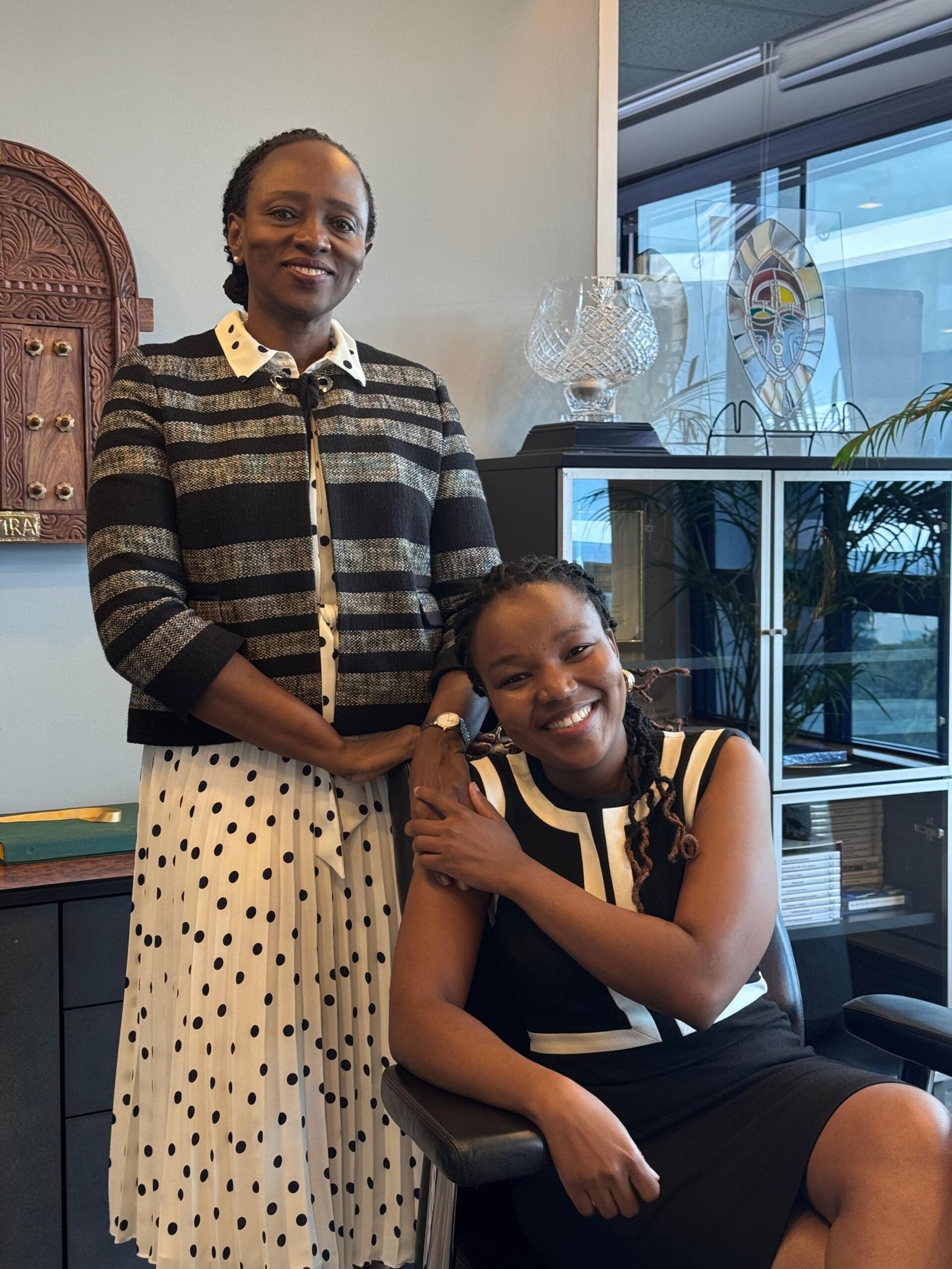
But the colour coordination felt almost symbolic of the relationship between them. Clear. Honest. Without grey areas. A connection where nothing important is left unsaid. What I did not know as I sat down to begin the interview was that the harmony between them extended far beyond their outfits. Over the next hour, I would witness something rarer; a mentorship that had grown into friendship, family, and shared purpose.
A meeting that began with trust
When Hope Murera first met Mirriam Mueni, she decided to do something unusual. She brought her whole family. Her children, her sister… everyone. “I wanted her to feel she was coming into a real space, not just a formal meeting,” Hope explains.
It was 2014, and Mirriam was still a student at Starehe Girls’ Centre. The two had been matched through the mentorship program at Global Give Back Circle, but they had only exchanged a few emails before that day. They were still strangers. Yet, Hope came in with her whole village.
For Mirriam, it was overwhelming and unforgettable.
“My classmates couldn’t believe it,” she recalls with a laugh. “They kept saying, ‘They kept saying Mirriam has been visited by this whole family!’” What Hope was offering that day was more than mentorship. She was offering trust and friendship. And that trust would grow into a relationship that has now stretched across more than a decade, from a rural village in eastern Kenya to the halls of Oxford University and back again to the Kenyan corporate world.
A girl from a dry village
Mirriam’s journey began far from Nairobi’s boardrooms. She grew up in Kibwezi, deep in Kenya’s semi-arid eastern region. Her mother died when she was nine years old. She and her siblings were raised by their grandparents and an uncle who relied on subsistence farming in a place where rain can disappear for years at a time. Life revolved around basic needs. “The conversations at home were never about careers,” Mirriam remembers. “They were about the next meal.” There were eight cousins in the household and few resources to go around. Clothes were passed down from child to child. Food was often bought in small portions from local shops. Yet teachers began to notice something remarkable.
Mirriam was consistently at the top of her class. Those teachers stepped in, helping fill out school applications and organizing the supplies she needed. Their intervention helped her secure a full scholarship to Starehe Girls’ Centre, one of Kenya’s most respected schools.
Looking back, Mirriam sees that moment clearly. “It was the first time someone stepped in and opened a door,” she says. Years later, another door would open through mentorship.
A mentor who remembered her own journey
Hope Murera understands the power of opportunity because her own life was shaped by it.
She is Rwandan by heritage, but her parents fled to Uganda as refugees in the late 1950s. Hope was born there and grew up in a refugee community. Her education came through UNHCR scholarships, awarded only to students who consistently performed at the top of their class. “My parents would never have been able to afford my schooling,” she says. “I never even knew who paid for it. But I knew if I worked hard, someone out there would come through.”
Education became her pathway forward.
She studied law and later built a career in insurance, joining the industry in 1994. Over nearly three decades she rose through the ranks to become Chief Executive Officer of ZEP-RE (PTA Reinsurance Company), one of Africa’s leading reinsurers. But success never erased her memory of what it meant to grow up without opportunities. “I know what it feels like to be a disadvantaged young girl,” she says. “Education is an equalizer.” So, when she encountered Global Give Back Circle, an organization focused on mentoring and empowering young women, the mission immediately resonated. “It aligned with something very deep inside me,” she says.
When mentorship becomes partnership
Hope initially expected a traditional mentorship relationship. But Mirriam quickly proved exceptional. “She was very focused,” Hope says. “Disciplined. Curious. It was easy to mentor her.” Instead of offering instructions, Hope mostly asked questions.
Why are you making this decision?
What do you want your future to look like?
What comes next?
For Mirriam, those questions became a powerful form of guidance. “I don’t think Hope has given me many answers,” she says. “But she has asked the right questions.” Those questions shaped many turning points in Mirriam’s life.
After finishing university with a first-class degree, Mirriam planned to begin working immediately. But Hope challenged her to think bigger.
“You have a first class,” she told her. “Why are you not applying for international scholarships?”
Mirriam applied and after numerous attempts, she was awarded the Rhodes Scholarship, one of the world’s most prestigious academic awards, becoming one of only two Kenyan scholars selected that year to study at the University of Oxford and Hope and her daughter travelled to attend Mirriam’s graduation.
“It was a beautiful moment,” Hope says. “Watching her stand there.”
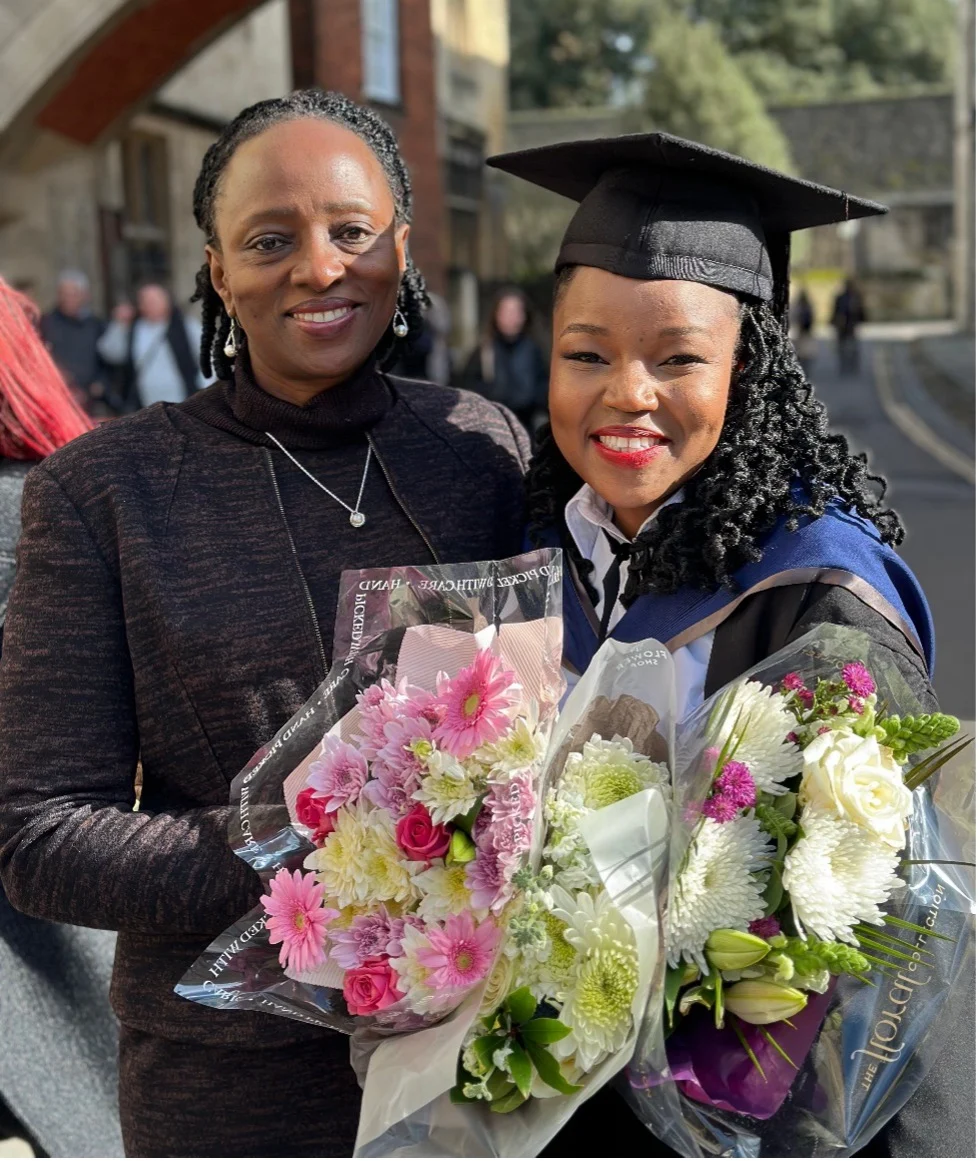
Hope Murera stands with her mentee Miriam during Miriam’s graduation at the University of Oxford as a Rhodes Scholar.
Opening doors
Mentorship did not stop at advice. Hope also helped Mirriam access opportunities.
During university holidays, Mirriam interned at ZEP-RE, where Hope worked. She rotated through multiple departments including investment, claims, and underwriting gaining exposure to corporate life early in her career. Hope also introduced her to senior executives. “I would say, this is my mentee,” Hope recalls. “And that changes how people engage with you.”
For Mirriam, those introductions mattered. “They gave me exposure,” she says. “I could see how the corporate world works.”
After completing her studies at Oxford and spending a year working in London, Mirriam returned to Kenya.
Today she works at ZEP-RE as ESG Manager, helping guide the organization’s work on sustainability, climate risk, and corporate responsibility.
The unexpected gift of giving
Mentorship, Hope says, is not a one-way relationship. “You gain when you give,” she says simply. Over the years, the relationship with Mirriam has brought unexpected joy. “She has helped me grow as a person,” Hope says. “It builds empathy. It expands your heart.”
The mentorship has also influenced Hope’s leadership style. Today, women make up the majority of ZEP-RE’s executive team, something she has championed deliberately. “If we don’t open doors for each other, progress will be very slow,” she says.
For Mirriam, mentorship has shaped her own sense of responsibility. She now mentors young women herself including students from Starehe Girls and girls from the rural communities she grew up in. “Sometimes mentorship is just letting someone see what is possible,” she says.
Give to Gain
The theme of International Women’s Day this year “Give to Gain” captures the essence of their journey. Hope believes the principle reflects a deeper truth about life. “Research shows that your brain responds the same way when you give a gift as when you receive one,” she says. “Giving builds you.” Mirriam agrees. “Success should not mean climbing alone,” she says. “When you share opportunities, you create a network where everyone grows.”
Their story shows how that principle works in practice. A refugee girl receives scholarships. She becomes a leader. She mentors another young woman. That young woman returns to mentor others. The circle expands.
Hope often reflects on the simple truth behind it all. “If someone had not opened a door for me,” she says, “I would not be here.” So she keeps opening doors.
Because somewhere, in a small village where the future feels uncertain, another girl is waiting for her chance.